
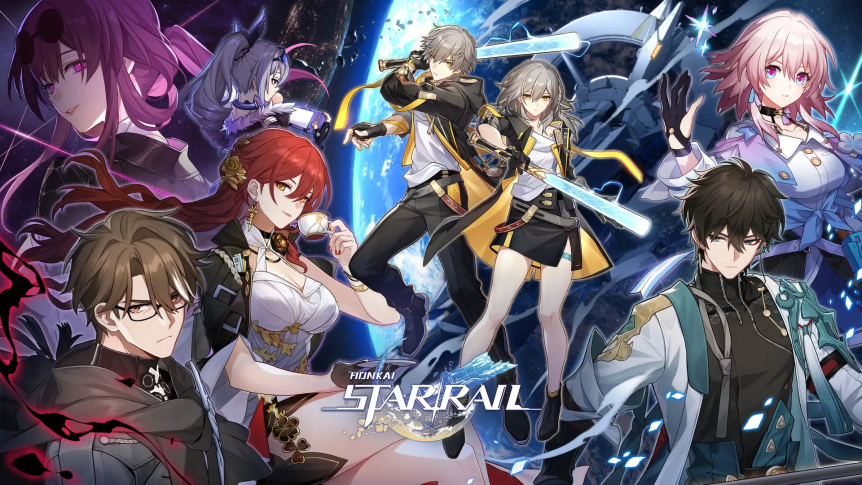
- Title: Honkai: Star Rail
- Platform: Microsoft Windows (Official Launcher)
- Also available on Android & iOS
- Developer: HoYoverse
- Publisher: HoYoverse
- Played: Version 1.0 | Trailblaze Lv. 58 | Equilibrium Lv. 4 | Main Story Completed | Far too much money spent in real life
Following the huge and ongoing success of Genshin Impact, HoYoverse/miHoYo returns to their Honkai franchise with a new installment, Honkai: Star Rail. In contrast to the real-time action provided in Genshin and Honkai Impact 3rd, Star Rail is a turn-based RPG. While a surprising and atypical decision for HoYoverse to take with their latest game, the developer pulls through and delivers another fun and engaging title for their catalog. They also offer much of the same nonsense found in their other works.
I. Stelle the Tank Engine
Self-contained from previous Honkai titles, Honkai: Star Rail takes place in the far reaches of space where civilizations worship the paths of deities known as Aeons. The story primarily revolves around the “Trailblazer” (Rachael Chau/Caleb Yen), an amnesiac imbued with a Stellaron, a disruptive source of cosmic energy. They join a band of other trailblazers and embark on a trainlike space ship called the Astral Express, traveling to various places to investigate cases involving the Stellaron. In addition to the residents of each area they visit, the Astral Express also runs into the Stellaron Hunters, wanted criminals who mysteriously assist the Trailblazer on their journey. Currently, the main story primarily consists of three arcs, respectively set in Herta Space Station, planet Jarilo-VI, and a spaceship called the Xianzhou Luofu. The third arc set aboard the Luofu is ongoing, as of Version 1.0.
At launch, Star Rail‘s main story is off to a strong note. The Astral Express crew are a fun bunch. While a blank slate for the player to take shape, the Trailblazer can have a lot of personality to them thanks to the game providing a lot of fun dialogue options. Often at times, the player is free to make the Trailblazer take the plot seriously or turn them into a complete weirdo or gremlin that confounds everyone else in the room. It’s all inconsequential but it’s all good fun nonetheless. The Trailblazer also develops a strong and charming rapport with two of their crewmates, the energetic March 7th (Skyler Davenport) and the quiet Dan Heng (Nicholas Leung). The three of them form a chaotic bunch that works well in the game’s more lighthearted moments. The other two crew members, Welt (Corey Landis) and Himeko (Cia Court) don’t have a lot to do as of Version 1.0, though Welt does assume a more prominent role in the Luofu arc and his insightful personality lends itself as well as a diegetic mouthpiece for the game’s exposition.
By far, the highlight of the main story is the second arc set in Jarilo-VI. The lore and the stakes surrounding the planet are really interesting. The arc seamlessly alternates between whacky hijinks and genuine drama. Almost every major character in the arc has something to do or contribute. It would not surprise me if HoYoverse fans come to regard this story arc as one of the best the company has ever produced. The other arcs are perfectly fine. The first one set aboard Herta Space Station is effectively Star Rail‘s prologue and tutorial. It’s shorter than the subsequent two arcs and it moves along quickly so that you can get into the actual overarching plot of the game. Those who want to get the most out of that area and its cast of characters may want to indulge in Star Rail‘s sidequests. The Luofu arc is incomplete as of Version 1.0 so it can’t really be evaluated in full. So far, it does provide some clarity over the Stellaron Hunters’ role in the plot and there’s some intrigue going on with Dan Heng. However, the arc has yet to click for me in the same way the Jarilo-VI arc did. It’s clearly building up to something but it feels aimless until Hoyoverse patches the game with the payoff. There’s also this odd subplot involving a NPC that does play into the Luofu’s lore but it’s placed awkwardly between other story beats and it lacks the involvement of any major character besides the Trailblazer. I could not help but wonder if it’s a last minute addition to the story.
II. Seele, Let Everyone Else Have a Turn!
As mentioned earlier, Honkai: Star Rail utilizes a turn-based combat system. The player takes control of a team of four characters that each take turns with the opponent(s) in any given battle. Characters deal one of seven different types of Elemental damage: Fire, Ice, Imaginary, Physical, Lightning, Quantum, Wind. They also assume one of the seven classes or “Paths” as they’re called in the game: The Hunt (single-target damage), The Erudition (multi-target damage), The Destruction (jack of all trades), The Harmony (buffing), The Nihility (debuffing), The Preservation (shielding and tanking), and the Abundance (healing). Stats can be augmented with two forms of equipment. The first is a fancy PNG file a special item known as a Light Cone. The second is a group of gear called Relics, which is further divided into two sub-groups: Cavern Relics and Planar Ornaments.
Barring passives, each playable character has three abilities: a basic attack, a Skill, and an Ultimate. Skills require the use of a Skill Point. One Skill point is generally obtained when you execute a basic attack and up to five Skill Points may be held by the player. Ultimates require the consumption of Energy, which characters generally obtain by casting their other two abilities or when they get attacked by an enemy. Casting an Ultimate is independent from the turn order and is treated as an extra turn. So long as the character in question has a full Energy gauge, you can activate their Ultimate whenever you want, even in the middle of an enemy team’s turns.
That every character only has three abilities to execute may sound limiting on paper. To HoYoverse’s credit however, they make it to work to engaging effect. By only having three abilities, characters feel specialized and well-defined in their Path. More importantly, team composition becomes important as you can only have so many abilities to add to your team’s repertoire. Another factor to note is the surprising amount of juggling you have to do with Skills and Ultimates. At times, you’ll have to smartly alternate between basic attacks and Skills so that you have a healthy amount of Skill Points to use for your rotation and to accommodate any variables thrown at you. Most Ultimates are best casted once their respective character have enough Energy though there are situations where you may want to save them for later. For example, if an Ultimate provides teamwide healing, it is best to save it until you take massive teamwide damage or for an emergency.
About the only fundamental issue with the ability system is that combat can look and sound very repetitive. Seeing the same animations and hearing the same voice lines is admittedly par for the course with turn-based RPGs. However, it gets especially prevalent in Star Rail because each character only has three animations to perform with their kit. They also don’t have a lot of voice lines to say, with their Ultimates being accompanied by a single voice line. Combined with the daily grind and the lack of a skip option, combat gets monotonous, more so than it would in a non-gacha RPG.
Every enemy in Star Rail has a “Toughness” gauge that goes down when they take Elemental damage that they are weak to. Once their Toughness is depleted, a Weakness Break will occur. The enemy will take extra damage, have their turn delayed, and take a status effect related to the Element that procs the Weakness Break. The Toughness mechanic adds some additional strategy to combat. Breaking Toughness can become crucial in manipulating the enemy AI and/or turn order to your favor or surviving a challenging fight. Toughness also gives you the incentive of saving your offensive Ultimates as Ultimates not only deal high bouts of damage but also a sizable dent into an enemy’s Toughness bar. Since you can only have up to four different Elements available in your team and since not every character is a damage dealer, the devs wisely give every enemy more than one weakness and they don’t give any of them immunity to any Element. That way, you’re not severely limited in creating an effective team comp.
Combat in Star Rail can be engaging and exhilarating but it doesn’t always give that impression. As you advance your account and improve your characters’ builds, the game gradually gets easier. Eventually, difficulty becomes non-existent outside of select occasions. Star Rail does provide an auto-battle function so that you can breeze through encounters with jobbers but there is something to be said about the game if most of the combat is auto-battling and that your first decision in a given fight is whether or not your team can handle things without your input.
Outside of combat, Star Rail has you navigate different maps representing the different areas the Astral Express crew visit. These maps are not an open-world like with the world of Teyvat in Genshin Impact though HoYoverse does take some inspiration from their previous title by populating each map in Star Rail with a number of chests for you to open and puzzles for you to solve for even more loot. That said, it is obviously not as dense as it is in Genshin. Oddly enough, you can alternate between any of your four characters in the world like you can in Genshin though this is justified in two ways. The first is that you can initiate a preemptive strike on an enemy and the damage of this strike depends on the Element of your on-field character. The second is each character has a “Technique” that aids you in exploration or allows you to perform a stronger preemptive strike with extra effects, provided that you have at least one “Technique Point” to do so.
III. Pom-Pom is Scamming Me
Naturally, since it’s worked so well with HoYoverse’s previous titles, Honkai: Star Rail employs yet another gacha system for you to try your luck and/or money on. It’s scummy, it’s predatory, but it’s also something you’ll have to work with as you play the game. In the so-called “Warp” system, you pull to get characters and Light Cones for your account. Both types of drops vary in rarity, with 5-Stars being the highest one. Character dupes net you additional passives called Eidolons while Light Cone dupes can be merged via a mechanic called “Superimposition”, into one copy of said Light Cone but with an augmented passive. Star Rail provides two limited-time banners, one for characters and another for Light Cones. Both banner types feature one 5-Star and three 4-Stars. Outside of those, there’s the standard banner with no particular bias to anything in its drop pool and a beginner’s banner that expires after you pull 50 times.
Pulling requires a specific currency called Star Rail Passes. Standard banner pulls require a normal pass while limited banner pulls require a Special Pass. While you’ll obtain either currency in a couple of ways, you’ll more often obtain a second currency called Stellar Jades which can be exchanged for either type of Star Rail Pass or be used outright for pulling. Among other things, these are generally obtained by progressing through the story, completing daily tasks, and participating in special in-game events. Pulling 4-Stars and 5-Star dupes will net you Undying Starlight, tokens that can be exchanged in the in-game shop for items, including either type of Star Rail Pass. Those who love burning money can swipe their credit card to obtain Oneiric Shards, the P2W equivalent of Stellar Jades that functions the same way.
Star Rail utilizes the same pity mechanic as Genshin Impact. Every 10 pulls guarantees you a 4-Star drop and every 90 pulls (80 in the cases of the Light Cone banner) guarantees you a 5-Star drop. Though not officially stated, there is a soft pity where the 5-Star drop rate increases after a certain number of pulls. Banners have a 50/50 chance of giving you the featured 5 star but if you fail it, you are guaranteed that featured drop in the next 90 pulls. Pity count carries over to the next banner(s) so your guarantee doesn’t go to waste can be alternatively used for the next featured 5-Star. Likewise, Star Rail‘s potential price tags is the same as Genshin. Worst case scenario, a maxed out character or Light Cone will cost thousands of dollars though if you really want to play Devil’s Advocate, the cost does go down a ton due to the RNG of the gacha and the ability to use Undying Starlight to exchange for more Star Rail Passes. As always, you should only whale to whatever extent is comfortable for you and if you have the money to spare.
To HoYoverse’s credit, Star Rail is a little bit generous with its F2P offerings, certainly more than Genshin ever was. Aside from the usual handful of free characters, you can actually unlock some 4-Star Light Cones as well as three 5-Star cones by progressing through the game’s endgame modes. Undying Starlight can be exchanged for characters and, more surprisingly, the 5-Star Light Cones found in the standard banner and this exchange resets monthly. The beginner’s banner is guaranteed to give you a standard 5-Star character within its 50 pull count. You can unlock a standard 5-Star character selector after pulling 300 times in the standard banner. Mind you, all of these require a lot of playing and a lot of patience but at least they’re there. It’s not like Genshin, where some of these options don’t even exist.
IV. Darn Game Won’t Let Me Get a Good Ring for My Waifus
Honkai: Star Rail has a daily loop that generally consists of two components. The first is fulfilling daily tasks the game arbitarily gives you. Daily tasks generally comprise of simple tasks that you’d normally do anyway such as “fight x amount of enemies” or “proc Weakness Break x amount of times”. A notable exception is the Daily Mission which is a basic sidequest that has you helping a NPC. Daily tasks in Star Rail is a slightly better version of the Daily Commissions seen in Genshin Impact, if only by virtue of there being just one quest as opposed to four and the fact that some tasks can be completed while you’re farming stuff with your Trailblaze Power.
Aside from daily tasks, as well as occasionally fighting jobbers for materials, Star Rail‘s daily loop has you using Trailblaze Power, the game’s stamina system. Power is needed to gain Relics or the various materials you need to build your characters after completing combat challenges and boss fights located throughout the game’s world. A maximum of 180 Power can be held by the player and it naturally refills over time (though there are ways to instantly refill for free or with money). All modes that involve Power lets you immediately repeat it upon completion and some also let you fight through more than one wave so long as you have corresponding amount of Power needed, both of which are nice quality of life features. To Star Rail‘s credit, all items outside of weekly boss drops can be farmed every day. It’s not like Genshin where certain drops are gated to certain days of the week, which is really annoying. There’s also slightly less item types to concern yourself with in this game compared to Genshin.
That said, a lot of farming is required for your account, especially as you transition into the endgame, and you will have to log in many times in order to farm. The potential monotony of Star Rail‘s combat becomes especially egregious here as you will be doing the same encounters over and over again. Auto-battle comes in handy here but that proves my point that most of the combat devolves into having the game play itself. Really, the grind would be a lot more tolerable if a lot of these activities offered a Skip function, a common feature in gacha RPGs.
Out of all the item drops in the game, the most egregious type are the Relics. By the endgame, Relics make or break your builds. However, getting the pieces you need takes nebulous and obnoxious amount of time due to stat allocation being complete RNG. It’s very much akin to farming Artifacts in Genshin. To be honest, I’d argue it’s actually worse here in Star Rail. As mentioned earlier, there are two types of Relics: Cavern Relics and Planar Ornaments. Whereas Genshin wants you to farm one set of Artifacts for each character, Star Rail demands that you contend with the RNG drops of two. Genshin also offers some leniency as you need four out of five pieces to be of the same set in order to have a full set bonus. By contrast, Star Rail‘s Relics does not allow you have an off piece, making the grind for solid Relics a lot stingier and more annoying.
V. Herta’s Web3 Scheme
Prior to the game’s launch, endgame was my biggest concern for Honkai: Star Rail. Honkai Impact 3rd has developed a pretty sizable endgame but Genshin Impact‘s is insultingly lackluster so HoYoverse could go either way with Star Rail. Now that the game is out, I can give Hoyoverse credit in that they launched Star Rail with two endgame modes, which is automatically better than the pitiful one provided in Genshin.
The first mode is Simulated Universe, a roguelike where you fight enemies and obtain buffs in preparation for a final boss. While progressing through Simulated Universe, you can spend Trailblaze Power for Planetary Ornaments. Playing Simulated Universe enough times will also let you claim weekly rewards. This is easily one of the best modes found in Star Rail. Not only is it distinct from the other forms of repeatable content, it is a lot of fun obtaining and combining different buffs to improve your chances of success. That said, I question the decision to make this a source of gear. Farming Planetary Ornaments isn’t practical should you fail a run and due to how much time you need to spend progressing through the roguelike. Because of the weekly reward limit and the need to grind for other things, you shouldn’t really tackle Simulated Universe every day but that might also impede your ability to get good Relics.
Aside from Simulated Universe, there is also the Forgotten Hall. This is essentially a turn-based version of Genshin‘s Spiral Abyss in that it has you taking on an evolving lineup of enemies. Instead of a time limit like in Genshin, your performance in the Forgotten Hall is based on the number of turn cycles you have left. While that can or may be fun to play, I am concerned with how this mode will evolve over time. In Genshin, Spiral Abyss is often a giant mess featuring stingy win conditions, hyperaggressive enemies with absurd amounts of health, and limiting options for team comps. It’s entirely possible that HoYoverse might throw these into Forgotten Hall down the line to incentivize pulling for new characters and Light Cones. Another concern is that because Forgotten Hall revolves around how many turn cycles you have left, the mode might heavily favor characters who can manipulate turn order or gain extra turns. This could cause a dangerous amount of powercreep in future updates.
Conclusion
Honkai: Star Rail is a different game from HoYoverse that delivers more of the same. It’s different in the sense that it’s a departure from the developer and publisher’s MO, offering turn-based combat in lieu of the real time action seen in their previous titles. To HoYoverse’s credit, the combat in Star Rail is pretty good with some solid mechanics and a surprising amount of depth. At the same time however, it is yet another live service gacha that has much of the same pitfalls found in HoYoverse’s other games, certainly Genshin Impact at the very least, such as an inconsistent sense of difficulty and an obnoxious grind. I have been enjoying the game so far, largely in part to the combat as well as the story, but I’ve also been in the early honeymoon phase of the game and I’m wary of how the game will shape up in the future.
Score: 6/10
 Xenodude Scribbles
One thought on “Honkai: Star Rail (PC) – Review”