
Out of all the TV episodes in Revue Starlight, this one was the one I was looking forward to rewatching the most. It is easily my favorite one out of the bunch. A lot of my adoration is attributed to the revue of the week. I think it has the best fight in the entire show as well as the best insert song. I also just think it’s a really good episode that does a terrific job exploring its featured character.
At long last, we get an episode centered around Hikari. I’ve generally liked her up until this point but I can’t deny that her character has largely been in service of others. Mahiru initially saw her as rival. Nana views her as a curiosity. Most importantly of course, she’s Karen’s dearest friend and her biggest reason for partaking in the revues. You do get to know more about Hikari in Episode 4 but in general, I feel that she has arguably been more of a plot device than a character, albeit a very interesting one. It’s a little strange as Hikari is the deuteragonist of the series, second only to Karen. Well, all of that changes for me in this episode. This is an episode where Hikari truly shines and it helps you understand where she’s coming from — her aspirations, her turmoil, and her resolve.
Episode 8 opens up with yet another stylistic re-enactment of “Starlight”, witnessed by younger versions of Karen and Hikari. This doesn’t really provide any new information about the play. At this point, you’re probably thinking that the show really needs to give us an explicit explanation about this darn play. Still, it’s kind of important for the show remind us of the significance this play has on Karen and Hikari, especially after Episode 7 hinted at even stronger parallels between it and what’s been going on in the show.
From there, the first half of the episode primarily takes place in the past around the Royal Academy of Theatrical Actors in London, the school where Hikari studies before she transfers to Seisho in the present. Hikari gets ready for the day and a montage of her studying and practicing then plays. This first scene reminds me of the opening of the series premiere, which had Karen going through similar motions. Both scenes even have Karen and Hikari grabbing their respective hair clip before leaving their dorm. The key difference here is that Hikari can actually get ready for a given day and she’s doing quite well at school. Compare this to Karen who starts off rusty in class and initially needs Mahiru’s help to get ready. Admittedly, Hikari can’t keep her room clean but that’s besides the point. The self-sufficiency on display here kind of relates to something the episode brings up a couple minutes later.
Alongside this scene, you hear Karen narrate one of the letters she wrote to Hikari while the latter was studying in London. You then hear Hikari’s response to the letter which is curious as it was established in Episode 4 that Hikari maintained radio silence with Karen for twelve whole years. The implication then is that Hikari really did want to write back and this narration of hers is what she wanted to say to Karen while she was away.
We then get a flashback within a flashback; a little odd but whatever. This scene has Karen and Hikari as little kids and it depicts Hikari telling a distraught Karen about her plans to study abroad in London (or “Dondon”, according to Karen) and cutting contact until she finishes her studies. While I can understand wanting to take the opportunity, Hikari’s decision to go abroad is a bit strange. After all, Hikari wants to become a star with Karen and yet, she seems determined to get there by herself first. It’s something to keep in mind as the episode goes on.
Interestingly, this scene takes place in the playground near Tokyo Tower, the same one where Karen and Hikari reconcile twelve years later, as depicted in Episode 4. In fact, it’s almost a direct contrast to the previous scene. In the present, Karen tells Hikari that the two of them can accomplish anything together. Conversely, in the past, Hikari says that going their separate ways is how they’ll achieve their dream. In Episode 4, Karen helps Hikari up the slide, right as the two agree to trek through the revues together. Here, the reverse happens and Hikari is the one helping Karen up. The dialogue is somewhat similar however as you have Hikari assuring Karen that they’ll see each other at the destination of their journeys.
The flashback within a flashback ends with Karen and Hikari purchasing and exchanging hairclips, the same ones that they continue to wear in their adolescence. It’s a fitting and cute way to end the scene. This far into the show, you’ve probably figured out why Karen’s hairclip is shaped like a crown while Hikari’s hairclip is shaped like a pair of stars. The crown-shaped hairclip alludes to the Top Star and Karen’s journey to become it. Meanwhile, Hikari’s hairclip refers to her and Karen’s promise to be stars as well as “Starlight” and the play’s connection to the two characters. As for why there are two stars, the show does explain that but I won’t spoil it here.
Eventually, Hikari is approached by the giraffe about the revues. Enticed by the power of the Top Star, Hikari agrees to participate in the competition. Unfortunately, Hikari ends up losing to a classmate for the Top Star’s crown. After the auditions, Hikari notices that she isn’t as good at the performing acts as she was before. This leads her into realizing that there’s a huge catch to the revues: anyone who loses in the auditions loses their shine so that the Top Star has enough power for themselves. That Hikari participated in the Revues before and lost doesn’t surprise me too much. One, it seemed in Episode 2 that she and the giraffe are already acquainted with one another. Two, it wouldn’t make sense for Hikari to compete again in Tokyo if she had managed to win over in London. The same can be said about the revelation about what happens when you lose the revues. There had to be a catch of some kind with the competition and it had to be dire enough to justify Hikari’s initial opposition to Karen’s participation in the auditions.
Really, the big takeaway is that somewhere along the way, Hikari seemingly forgot what she was fighting for: to be a star with Karen. This is how Hikari’s decision to study alone backfires on her. She got so focused on her goal of becoming the best that it became something she was doing for herself and not for herself and Karen. It even takes some time for Hikari to realize why her loss in the revues disturbs her more than it already does. Losing your shine sounds frightening already but it’s increased tenfold when Hikari realizes that she has jeopardized her promise with Karen.
Even real life begins to reflect the pain she’s going through. For the class play, Hikari plays the role of a fallen empress; trembling in fear and unable to fight back. What her peers don’t realize though is that the fear is quite genuine; Hikari is trembling because she thinks she has failed Karen. Furthermore, she’s alone, the only one clinging onto the “empire” she built for herself only to see it fall apart before her eyes. Also symbolic, albeit more cheeky and amusing, is that when Hikari realizes the consequence of losing the Revues, there’s a giraffe skeleton behind her. It reflects the lack of shine she currently has…that or Hikari really wants to kill the giraffe…
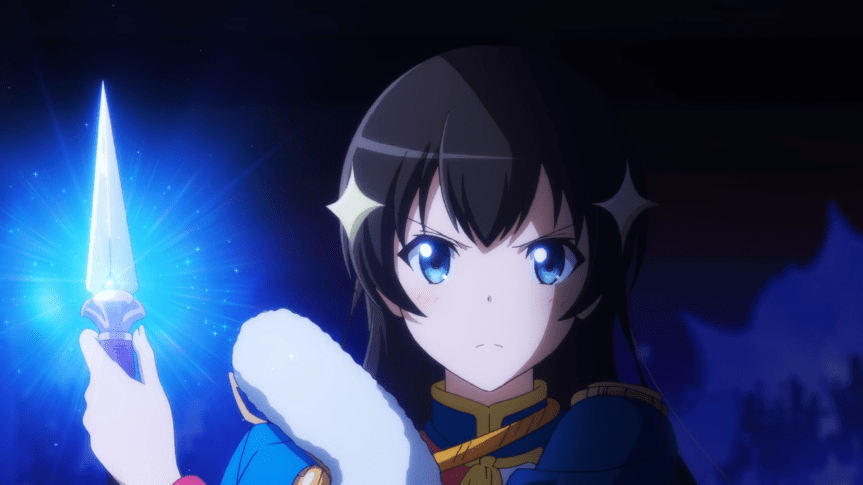
Naturally, Hikari is desperate for a second chance so she decides to confront the giraffe about it. I like how Hikari’s loss in shine is reflected with her weapon. During the London revues, she fights with a sword, just like Karen. Upon losing her shine however, the sword is shrunken down into the dagger that Hikari wields in the present. That Hikari still has a weapon is actually pretty important. It means that Hikari still has some shine left in her and she can still fight. Intrigued by this, the giraffe gives Hikari her second chance; this of course leads to the present, where Hikari partakes in the Tokyo revues. This is small potatoes but I’m honestly still trying to wrap head around the logistics of Hikari moving back to Japan on a short notice. Seriously, she acts like moving from London to Tokyo like it’s fast traveling in a video game.
After this scene, Revue Starlight finally returns to the present and it does so with a bang as it jumps right into the revue of the week. As teased in the previous episode, the duel is between Hikari and Nana. This was bound to happen given Nana’s interest in Hikari but beyond that, there is a thematic weight to pitting these two against each other. Nana is stuck in the past. Hikari is looking towards her future with Karen. Both girls desire a miracle to make their respective dream come true. There isn’t much of a history between these two but they inadvertently are in direct opposition of each other.
Curiously, the revue of the week is titled the “Revue of Solitude”. How the title refers to Nana is easy. She’s the only one who seems to hold the 99th class’s first performance of “Starlight” in high regard and she’s the only one who remembers all of its repeat performances due to her time traveling. She is very much alone in her journey. As for Hikari, “solitude” could mean a couple of things. It could be referring to her decision to become a star on her own. It could also be an ironic title since Hikari is now pursuing her goal with Karen.
As I said at the beginning of this post, this revue is my favorite one in the entire show. I realize by saying that I make the remaining duels after this one sound inferior but I really do think nothing else in the show tops this particular fight. There is so much to love here – the direction, the music, the spectacle (oh boy is there spectacle).
Let’s start with Nana. I was curious how the stage would reflect Nana’s character but as it turns out, Nana doesn’t manipulate the arena at all. Nana pretty much pulls a Karen and simply waves her dual swords at Hikari. I suppose we already did get a glimpse of Nana’s stage last episode with the blinding lights but it would’ve been neat to see some of her influence here. That said, not having Nana manipulate the stage does sell how strong she is. Every opponent we’ve seen in this show, including Maya, has use the stage to their advantage. Nana acts as if she doesn’t need any gimmicks to win and to be fair, she does wipe the floor with Hikari for most of the fight. I also really like Nana’s facial expressions while she’s winning.
Since the stage isn’t influenced by Nana, it is entirely based around Hikari. Initially, the stage takes the form of the set for the play Hikari rehearsed for back in London. As the fight progresses however, the stage is set aflame, resembling the burning set used in the play. The two sets perfectly match what’s going on in the fight. Like, the stage is normal when the fight begins but as Hikari starts to lose and risk jeopardizing her dream with Karen, the stage shifts to the same setting where she realized she’s lost her shine and failed Karen the first time.
Just when it seems like Nana will win, Hikari’s determination and resolve causes her dagger to take on a new form. Instead of a plain old dagger, it now functions as a rope dart, allowing Hikari to zip across the stage like she’s Spider-Man. I like how the hilt sort of unfolds like a blossoming flower when it transforms. It’s very indicative to Hikari’s renewed shine as a Stage Girl. This is also a little funny to rewatch after watching and covering Yuki Yuna is a Hero. If I had a nickel for every time a character voiced by Suzuko Mimori evokes the image of a flower…
The climax of the fight is actually given its own title, “Act II: The Flower, In Bloom”. It’s a bit unprecedented but it does befit Hikari’s second wind and her dagger literally blossoming into a new form. Honestly, the climax deserves its own name because it is one of the most glorious moments in the entire show. To start off, the Tokyo Tower replica in theatre plummets into the water surrounding the stage, creating a giant wave that covers the arena. Hikari and Nana then duel underneath the wave and this somehow results in Hikari shattering the wave. As if that isn’t enough, Hikari shows off her new rope dart, whirling around the stage, before finally landing a clean hit on Nana’s jacket.
Funnily enough, there is still some symbolism to what’s going on. Tokyo Tower’s appearance is well timed with Hikari’s second wind and it acts as reminder of her promise to Karen. The use of water extinguishing all the flames on the stage represents Hikari moving on from her failure. It’s very fitting that Tokyo Tower, the symbol for Hikari and Karen’s promise, is what causes the water to rise up and douse the fires. There’s definitely more to this scene than just spectacle. That said, I can’t deny that my first thought about this scene is how just how awesome it is. I mean, come on! It has Tokyo Tower plummeting down and creating a giant wave!
Episode 8’s insert song is titled, “Re: Create”. The name alone stands out to me, given the two characters who sing it. Nana seeks to recreate the past and she pretty much accomplishes that by going back in time. With Hikari, it’s harder to say but my guess is that the title is referring to her reclaiming the shine she lost in the London revues. Honestly, it’s kind of funny that this title isn’t referring to Karen, the girl who is often saying that she is reborn. About the only thing I don’t get about the title is why there is a colon in between “Re” and “Create”. I don’t know, your guess is as good as mine.
I mentioned at the start of this post that I consider “Re: Create” the best song in the show. That’s of course subjective, not to mention a bold claim, but there are a couple of reasons as to why I love this song. For starters, there’s the superb singing provided by Hikari’s voice actress, Suzuko Mimori. I’m admittedly more familiar with her work now, having now seen Love Live! and Yuki Yuna is a Hero for example, but she’s got a great singing voice and this song really lets her show it off. The same can be said about Moeka Koizumi as Nana. Koizumi’s part is much smaller but she does a great job with the material; it’s made all the more impressive when you learn that Revue Starlight is her debut role in voice acting. Second, I really enjoy the composition of this song. The odd yet harmonious mix between electronic and traditional orchestra in the first third of the song. The orchestra giving 100% towards the end of the song. The music box-esque section that plays when Hikari recalls her promise with Karen and before she gets back in the fight. The smooth shift from melancholy and drama to hopeful and triumphant. The whole arrangement captures everything that happens in the fight and it’s simply beautiful.
The first verse of the song is sort of a lyrical battle between Hikari and Nana. You have Hikari reminding herself of her vow with Karen and to keep on fighting while Nana argues she doesn’t have to worry or suffer any more if she wins and turns back time. Save for one brief line sung by Nana, the rest of the song is entirely Hikari’s. In the second verse, Hikari talks about how her fate changed the moment she and Karen promised to be stars together and admit that she can’t accomplish the dream on her own. The last verse has her express her refusal to give up and her desire to be with Karen. Interestingly, Hikari refers to her promise as a seed that she and Karen planted when they were little and that has now bloomed into a flower. This coincides with her dagger literally blooming during the fight. Also, in the last line, Hikari says her bond with Karen can cause a miracle. That’s of course referring to the possibility of both girls becoming the Top Star. It’s a noteworthy line given the next and last scene of the episode.
Nana’s defeat is a little interesting. Not that I expect her to be a sore loser but you’d think she would have a reaction of some kind over losing. After all, it’s entirely possible that she’s never lost before so losing this revue ought to come as a surprise for her. Instead, Nana issues a warning to Hikari. She points out that “Starlight” is a tragedy that ends with the two main characters parting from each other. Knowing that Hikari and Karen are both aiming to be the Top Star, Nana thinks a similar fate awaits them and she asks Hikari if she’s ready for that to happen. While Hikari is likely sticking to her and Karen’s plan, her response to Nana suggests that she’s aware that it’s wishful thinking. It’s a surprising shift in tone after all the hope and determination Hikari expressed throughout the revue but it’s a necessary notion to bear in mind as the show comes to a close.
Watch Revue Starlight on HIDIVE
 Xenodude Scribbles